
By Oumou Diakité
Each year in Quebec, the Semaine d’actions contre le racisme et pour l’égalité des chances (SACR), the Week of Action Against Racism and for Equal Opportunity, creates a moment of reflection, mobilization and dialogue. The last week of March this year, this initiative brought together hundreds of organizations, institutions and citizens around common goals: fighting racism, and promoting a more just, inclusive, equal society
Created in 2000 to underscore the United Nations’ proclamation of an International Day for the Elimination of Racial Discrimination (March 21st), SACR is committed to a sustainable approach. It aims at preventing and combatting exclusion based on skin color, ethnic origin or nationality.
But beyond its educational role, over the years SACR has become a definitive political and social space. It allows for racism issues to be brought to light, to engage with institutions, and to propose concrete courses of action.
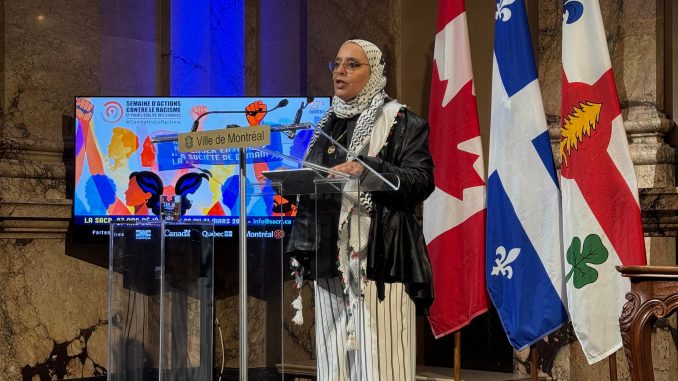
This year, in 2026, Montreal was the site of a particularly rich program, brought forward by several organizations working on the ground. The week’s launch was held at Montreal City Hall, in the presence of institutional partners such as the CIDIHCA and APNQL, all coordinated by Samira Laouni.
Panel discussions were held on such issues as systemic racism, housing and employment discrimination, as well as the lived realities of Afro-descendant and Indigenous persons.
The central colloquium, “Denied Identities, Murdered Identities – Voices for a Truly Plural Society”, brought together remarkable activists and social workers such as Ky Vy Le Duc, Zahia El-Masri, Karine Millaire, and lawyer Fernando Belton.
Participants in other panels included Sabine Monpierre, Jonathan Durand Folco, Viviane Michel, Ted Rutland, Samira Laouni and Ndeye Dieynaba Ndiayeto. They engaged in deep discussions about political dynamics, systemic violence and modern issues related to equality.
Parallel to this, the program included numerous participatory and educational workshops, meant for both young people and the general public. Organizations such as the Center for the Prevention of Radicalization Leading to Violence (CPRMV), ran training sessions on subjects such as “Understanding the Extreme Right: Ideas and Movements”, aimed at providing tools for participants given the rise of such discourse. These initiatives favored concrete exchanges about bias, inclusion, living together, by creating space for dialogue between different realities.
The cultural dimension occupied an important space, with films, Afro-Caribbean artists’ exhibitions, and other artistic events focussing attention on often marginalized subjects.
The week was peppered with citizen meetings and collective initiatives. All contributed to reinforcing the links between actors in the milieu and mobilizing around a cause: constructing a more just, inclusive society.
Collective Mobilization
The strength of SACR lies in its federative character. Each edition brings together a diverse range of actors: community organizations, public institutions, artists, researchers and activists.
These aren’t just symbolic activities. They create talking spaces, the sharing of lived experiences. They raise awareness of racism and discrimination. They also empower individuals and communities to better understand and respond to the mechanisms of exclusion.
Political figures like Ericka Alneus, leader of the opposition at Montreal’s city council, were present. She is a Black lady who epitomizes, in her own way, the importance of representation in the public decision-making sphere.
Her presence wasn’t just symbolic: she exemplifies a concrete commitment to issues surrounding equality, social justice and the battle against systemic discrimination. Seeing elected women from diverse backgrounds take part in these spaces helps to legitimize the discussions, but also reminds us that institutions have a key role to play in the transformation of social relations.
On a larger scale, the participation of public personalities in these activities give them weight. It sends a clear message: the fight against racism isn’t just for a select few to wage, it is a collective responsibility that has to be engaged in at every level of society, from the citizenry to public officials.
In short, the SACR acts as a bridge between individual experiences and systemic issues. It reminds us that racism is not limited to isolated acts, but is embedded in social, economic and political structures.
In 2026, “Resist and Unite”
The theme of this 27th edition was “Resist and Unite: Rethinking Tomorrow’s Society Together”. It comes at a propitious time. World-wide and locally racial issues are coming to the fore. Basic rights are being reconsidered. In Quebec, disputes on public religious symbols and Bill 21 are stirring up polarized debates on the boundaries between state neutrality and individual rights.
Here, resisting doesn’t just signify opposing. It also means not being indifferent, questioning injustices, and defending fundamental principles of equality and dignity. Uniting goes to the need to get over divisions to construct durable unity. These are notions that Samira Laouni, SACR coordinator, and Frantz Voltaire, SACR cofounder and president, raised in their remarks opening the week.
Rethinking Society: A Collective Task
Rethinking tomorrow’s society implies recognizing that living together is never something to be taken for granted. As the provincial Commission des droits de la personne et des droits de la jeunesse (Human and Youth Rights Commission) underlined at SACR 2026’s opening, this dynamic is built daily, in schools, workplaces, institutions and neighborhoods.
It takes into account the experiences of visible minorities, indigenous persons and immigrants. Racism continues to manifest itself in many aspects of daily life: employment, housing, education, and public safety. These inequalities aren’t simply anecdotal.
SACR invited a deep reflection on power relationships and the mechanisms that perpetuate these inequalities. It encouraged adopting an intersectional approach, which takes into account the different forms of discrimination and their interactions.
The Importance of Citizen Commitment
Another central aspect of SACR is the importance accorded to citizen commitment. The fight against racism can’t rely solely on institutions. It requires a mobilization on all levels: individual, community and political.
Participating in an activity, a panel discussion, engaging in a conversation or questioning one’s own biases are gestures that can contribute to transforming society.
SACR places the role of youth at the forefront of their initiatives. By arousing their interest and participation, SACR helps to influence a new generation to become more aware and engaged in addressing social justice issues.
10 Days, but a Permanent Struggle
Even though SACR took only 10 days, the struggle against discrimination is a year-round affair.
Each edition allows for progress to be measured. It also plots a course for the road to be travelled in the future. In a world where polarizing, populist politics is gaining territory, initiatives like SACR are vital. They offer a space where people can reflect together, reinforce their unity, and imagine alternatives.
In short, the Semaine d’actions contre le racisme et pour l’égalité des chances (the Week of Action Against Racism and for Equal Opportunity) is more than just an annual event. It is a mirror of the tensions and the hopes that criss-cross Quebec society.
Photo, top: Samira Laouni launches SACR at Montreal City Hall. Photo: Oumou Diakité
Leave a Reply