By Raymond Viger
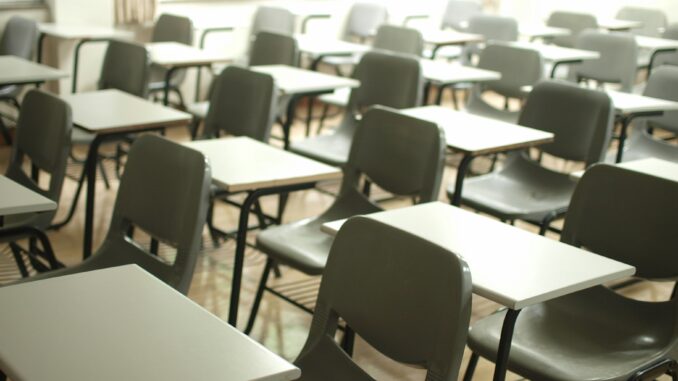
Why are schools no longer located in neighborhoods? Why were they replaced by schools with 2,500 students?
With local schools, children walk to school. Less school bus transportation. Less obesity among young people. Students arrive at school in a better frame of mind and more receptive to their lessons. After an hour on the bus, it’s no wonder they need to move around and jump around. Are we going to give them a prescription for Ritalin to calm them down? A small school can more easily be repurposed if it becomes less necessary for a given neighborhood.
School administrations create mega-schools to meet the ratios imposed by the Ministry of Education to obtain the funding to offer specialized support services for young people. This forces them to group students from a larger area into the same school, thus requiring the use of school buses. The decline of villages is killing small schools.
A community must be able to integrate its young people, its elderly, its people living with physical or mental disabilities… All these people who are different and who have different needs. Harmony is a balance between all these extremes. A society cannot live in peace if it neglects a portion of its citizens.
A sense of belonging to neighborhood life allows for better integration of its residents, who are no longer anonymous individuals limited to the daily grind of commuting, work, and sleep.
Fighting Poverty
A metropolis cannot turn a blind eye to poverty, which can become a cancer that eats away at its community. A conflict then arises between two opposing worlds: the wealthy, who want services and a better quality of life, and the poor, who simply want to stay alive.
We can limit ourselves to beautifying a neighborhood, renovating buildings, and increasing the number of housing units, pushing poverty ever further out. But how do we overcome it?
I knew an entrepreneur who made a lot of money and lived very comfortably. He only had a second-grade education. Skilled with his hands, he built houses his whole life. He confessed to me one day that if he had been born twenty years later, it would have been impossible for him to have the career he did. Because he would have needed all sorts of diplomas to get the cards and permits to hammer a nail into a piece of wood. With only a second-grade education, he would likely be poor and homeless. A minimum of a Secondary 3 (grade 9) diploma is required to access courses in construction trades. Some programs even require Secondary 5 (high school diploma).
According to some, the school system isn’t equipped to accommodate people who learn differently. Some succeed, hammer in hand, by observing and following more experienced people. For them, you learn to become a cabinetmaker by breaking your fingers with a hammer! What is more important? A diploma or professional independence?
Is one of the causes of poverty preventing people who learn differently from accessing a job more quickly? How can we achieve full employment if some young people don’t have access to it? Isn’t it the role of educational institutions to adapt to the young people they are responsible for instructing and educating?
Should educational institutions change their vision of education and their methods? Should schools take inspiration from alternative schools? A neighborhood school with greater autonomy to create and implement the curriculum based on the needs of young people. These schools require the contribution of the community, which is involved with its youth. Because it takes a village to raise a young person.
In elementary school, teachers are significant adults who remain with the same students for several years. A way to build a strong relationship between teachers and students.
Teaching
Teaching requires a burning passion, a true dedication. It is essential to support these adults in their mission. Their role is vital.
When a teacher reaches their breaking point, shouldn’t we help them find a new career path? We must prevent them from continuing to teach simply to maintain job security and collect their pension. A depressed teacher can no longer be a significant adult for a young person. They become a hindrance to the education system. It may be preferable to transfer them to another job where they can thrive and remain meaningful in a different way.
A professional airline pilot must undergo refresher training and medical examinations every six months to maintain their job. Because they are responsible for human lives, we want the pilot to have all the necessary skills.
The faculties and skills needed to reach the destination.
Why not do the same with our teachers? Should we create a professional order to regulate this profession? It is said that one becomes good by teaching. We lose 50% of our teachers within the first five years of their employment.
The goal of a society is to ensure the education of young people, to provide them with the necessary tools so that they can become happy citizens. Education can be achieved through observation, through trial and error. Schools must adapt to young people, in all their differences.
Just as the environment must be different for young people with special needs, it must be equally different for top students. Slowing down a top student in their learning is tantamount to academic suicide. A top student doesn’t want to operate at 75%. They want to learn at 120%… minimum. Dropping out isn’t just a problem for the last student in the class who can’t keep up. It also affects the top student who can’t wait for the others.
The pandemic led us to experience homeschooling with videoconference classes. Is this an alternative to traditional schools? A different way to keep our young people’s education in their villages?
- This text is an excerpt from the book Regard vers le futur, published by Éditions TNT.
Photo, top: MChe Lee on Unsplash.
Leave a Reply