
By Frédérique Lapointe
Located at 1800 Letourneux Street in the Mercier–Hochelaga-Maisonneuve borough, the Centre Social Anarchiste L’Achoppe (CSA), The Achoppe Anarchist Social Centre, is the setting for a way of life in which mutual aid, sharing, and community take the place of capitalist values.
Stepping through the door, I find myself in a simple, friendly, welcoming space — as if I had stumbled into an old memory. A piano to my left, a sofa, a stove, a few tables. To my right, pamphlets, calendars, and posters for upcoming events across the city — activist, protest-oriented, and anarchist activities.
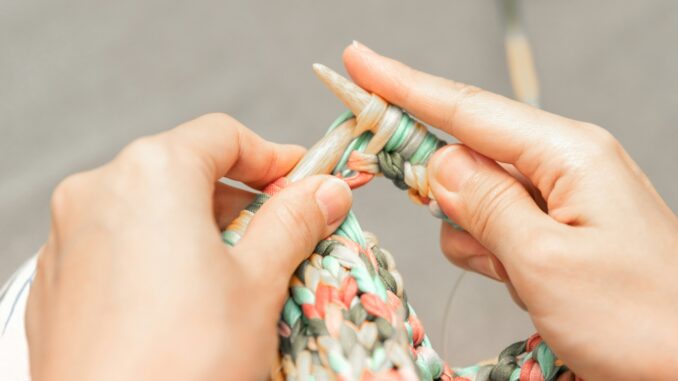
That very Thursday was the knitting session organized by Crochet Solidaire. It takes place twice a month. Knitting and crochet supplies are available to everyone in a cardboard box in the center of the main room. The icing on the cake? It’s all free.
The activity begins around 6:30 p.m. I am given a ball of blue yarn and some knitting needles. I am taught how to cast on stitches and how to handle the strands to tie a knot.
Family Feeling
I meet other participants. Without knowing their names or where they come from, I feel a sense of connection with them. There is a family feeling in the air.
Suzie (not her real name) explains to me how the knitting group came together. “I’d wanted to do some kind of activist crochet project for a long time.” She was introduced to the activity while listening to an episode of the podcast Live Like the World is Dying, created by Margaret Killjoy. The knitting and crochet workshop officially launched at the CSA in January 2026. Open to the public, “the idea is to bring life to the Achoppe and introduce people to it through the things that unite us,” Suzie says.
The young woman describes the experience as a collective learning process. Each participant can bring their own materials or borrow some on-site. “Starting a new hobby like knitting is expensive, and when no one around you knows anything about it, it’s intimidating,” Suzie adds.
Despite an exterior entrance that isn’t immediately welcoming, inside the building one finds a spirit of community and camaraderie typical of the CSA’s mission. “One day, someone told us, ‘You’re like an anarcho-queer women’s farming circle.’ I found the comparison funny,” says Suzie.
She hopes that the knitting activities will eventually attract older people. For now, the participants are mostly young people in their twenties. Suzie therefore adds that they will need to “reach out a bit to folks in the neighborhood.” In the meantime, she hopes to keep the activity going for as long as possible.
A Wide Range of Activities
Adam (not his real name) has been involved with L’Achoppe since 2024. He helps organize the space and makes the premises available to various groups. “Everyone here is a volunteer,” he says. In addition to Crochet Solidaire, other groups organize activities at the CSA, such as Justice Climatique Montréal and Comité Bails, which campaigns for more social housing.
“Everything here is political,” he continues, standing before a bookshelf filled with activist essays and dystopian, anti-capitalist novels. Anarchism — defined as a categorical rejection of all hierarchy or structures of domination and power — is perfectly reflected in this space. Within these walls, there is a refusal to belong to an all-powerful organization or to serve merely as a cold, minimalist, and — above all — fee-based gathering spot. The atmosphere at the CSA is subdued, suspended in time. Yet, it radiates a human warmth, a desire to come together and forge strong bonds.
To illustrate the venue’s vitality, Adam lists the recurring activities that take place there, including a “community meal” held twice a month, open to everyone. “We cook together. Usually, it involves discarded food or leftovers.”
He also mentions the monthly community dinners organized by the ORA (Anarchist Revolutionary Organization). Other time slots are set aside for evening drop-in sessions, allowing visitors to come into the CSA to rest, chat, or read. More than just a place of refuge, the space also hosts a variety of workshops.
Punk Past, Punk Future
The space was founded in 2007 under the name Rizhome. It was occupied by anarchists and punks during the 2010s. At the time, the property at 1800 Letourneux belonged to a private owner whom Adam describes as a “slumlord.”
In 2018, when the owner sought to sell the building, a grassroots effort was organized to preserve the site’s essential character. “When the building went on the market, the community didn’t want to lose it. They pooled their resources to buy it.” These efforts led to the creation of a non-profit organization, the Association pour la Réappropriation des Milieux Urbains (ARMU), which ultimately acquired the building.
L’Achoppe expanded a few years later. “But COVID hit after the takeover, and things were dead,” says Adam. “After a restructuring towards the end of 2022, L’Achoppe started attracting a lot of activist groups.” Today, the space houses two entities: the Anarchist Social Center and tenants, known as the colocs (French for roommates).
To sustain the building’s mission, a crowdfunding campaign was launched on the La Ruche platform in late 2025, raising $25,645 in just three months, alongside an additional $25,000 in funding from the Fonds Mille et UN pour la jeunesse. The money raised was used to cover essential maintenance costs for L’Achoppe, as well as to finance free activities for local youth.
Despite the obstacles and challenges, Adam welcomes the visibility the location enjoys, even though he accepts “only groups that share our values.” The result is a social center that stands deeply apart from tradition and the capitalist system — and, above all, a place of reflection radiating a powerful desire for mutual aid and community.
Photo above by Tanaphong Toochinda on Upsplash.
Leave a Reply