
Kathleen Couillard – Agence Science-Presse
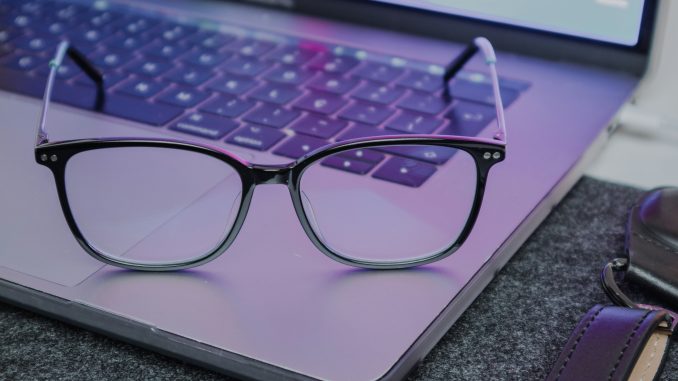
For several years now, blue light-blocking eyeglasses have been sold on the pretext that they protect the eyes from blue light coming off an electronic device like a computer screen or a cellphone. The problem, the Rumor Detector notes, is that there is very little proof that such eyewear is at all effective.
What is Blue Light?
The human eye can only perceive part of the light spectrum, the part that goes from blue to red. The Canadian Association of Optometrists notes that blue light accounts for a third of the visible light spectrum.
The sun is the main source of this light. But our electronic devices also emit quite a bit of blue light. It’s in this context that some have asked if there isn’t a risk of overexposure to blue light, say, notes Mark Rosenfield, a professor at the College of Optometry of the State University of New York.
Blue Light and Sleep
Light plays a major role in regulating our internal clock. What are called photosensitive ganglion cells in our retina capture light and transmit this information to the hypothalamus, a region of the brain involved, among other things, in regulating our wakefulness and sleep cycles.
In 2003, researchers in Boston discovered that our system is much more sensitive to blue light than to green light. In people exposed to blue light, the production of melatonin was greatly inhibited. Melatonin is a hormone produced when darkness falls. It contributes to our feeling sleepy.
In 2015, the same team of scientists concluded that using an e-reader blocked the secretion of melatonin, whereas this was not the case when reading a printed book. Among the 20 participants in this study, who alternated between the two reading methods over a two-week period, the e-readers increased the time needed to get to sleep and diminished their quality of sleep. According to the study’s authors, the composition of the e-readers’ light explained these results.
Blue Light and Visual Fatigue
Another negative effect was also attributed to blue light: eye fatigue. According to the Canadian Association of Optometrists, blue light is dispersed more widely in the eye, making it hard to focus and leading to fatigue.
Depending on the study cited, between 40% and 60% of people report visual symptoms such as fatigue, redness, dry eyes and vision problems when using electronic devices for extended periods.
There is no data showing that blue light causes all of this, Dr. Rosenfield stresses. In fact, the notion that exposure to this type of light has “a negative effect on ocular cells” hasn’t been validated by any study of the living human eye, says the Canadian Association of Optometrists – only studies on cultured cells or on animals.
The Efficiency of Glasses at Blocking Blue Light
Consequently, what is the impact of anti-blue light glasses? In 2019, Australian researchers evaluated seven types of commercial lenses. They blocked between 6% and 43% of blue light. According to the authors of this study, these lenses offered a certain protection against damage to the retina – if in fact there is any damage.
On the other hand, a few systematic reviews (2017, 2020, 2023) were carried out based on studies evaluating the effectiveness of these lenses in reducing visual fatigue or improving sleep quality. In every case, the authors concluded that no quality data exists showing convincingly that these products are effective.
For example, the scientists behind the 2020 analysis noted that several studies showed contradictory results. The researchers remarked that participants were very different from one study to another: teens or adults, healthy or with psychiatric issues. Moreover, the numbers of participants were small. Many types of lenses (brown, yellow, amber, orange) were tested and their effectiveness in blocking blue light could have varied.
In the end, the authors of the 2023 analysis underlined that no study followed participants for more than five weeks. It was therefore impossible to know the long-term effects of these eyeglasses. The researchers concluded that more studies were necessary and that there was insufficient data to justify prescribing blue light-blocking lenses to everybody.
The Verdict
Even if it is established that blue light can affect health, notably in terms of sleep, there is no hard data proving the effectiveness of eyewear designed to block out this light.
This article is part of the Détecteur de rumeurs series. Click here to read other articles in this series.
Leave a Reply