
By François Bellemare
Even in today’s modern times, the Inuit are known for consuming a lot of fish and meat that they hunt and fish for themselves. But very few know of the mechanism in place in Quebec Inuit villages that allows everyone to have regular access to this traditional food: The Nunavik Hunters Support Program aims to support and perpetuate Inuit hunting, fishing, and trapping activities.
In each of northern Quebec’s 14 Inuit villages, this service has its own office at the city hall. This is true in Kangiqsualujjuaq, where the local man responsible Tooma Etok gives us a general rundown:
“This program has three objectives: first, to assure regular access to traditional food at a time when a growing proportion of the population can neither fish nor hunt like before. There are several causes for this: low family income, as hunting has become a very costly activity; single parent families, a higher percentage of the population that is aging or socially isolated.”
Traditional Diet
Then there is the preoccupation for healthy eating. Fish and hunted meat have nutritional properties that the modern “western” diet, especially when everything is imported from the south (less fresh, more expensive, less varied). The third goal is to maintain hunting and fishing activities by subsidizing the hunters. This way, with the caribou hunt, for example, the hunter takes a share that he will eat with the rest of his family. The rest is sold to the municipality, which weighs the meat then keeps it in an immense community freezer. Each Inuit family can then go get a portion ofmeat or fish for free.
Many animal species aren’t covered by any specific protection measure. For the others (ex: beluga, whale, etc.) the system follows sharing quotas for each community.
In this case, the municipality divides up the small authorized take among the resident families, will go from house to house with a van and deliver a modest quantity to each household. In most villages, the usual practice is to leave the front door open, which provides access to a room large enough for a family freezer. That allows the deliverer to complete his tour of the homes even if nobody is at home.
The program should be seen as an integrated approach to both hunting and protecting species. One of the most protected is the narwal, with the twisted tusk it carries on its nose, which gives it its nickname “unicorn.” Kangiqsualujjuaq can’t hunt any narwal, yet the village still gets a small share of narwal meat from Inuits hunting in the Greenland Sea.
Traditional Clothing
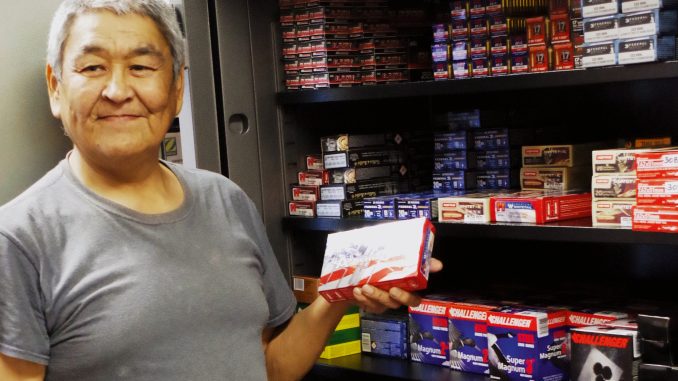
The program also has other facets. For example, the sale of munitions and equipment (mittens, parkas, etc.) to hunters. “In this case,” explains Tooma, “I buy accessories from suppliers to sell to hunters at a loss: buy for $100 at wholesale, and sell mittens, for example, for $50.”
Another goal is to maintain traditional clothes making activities in each village, which the women do themselves or within a community workshop. They can use animal skins taken from caribou, seals, wolves or rabbits.
Tooma adds: “We also have a saving mission. The day before yesterday, for example, we got a distress call from hunters whose motor on their boat broke down over 100 km north of their village. They were brought home safe and sound.”
The author has received an excellence grant from the Association des journalistes indépendants du Québec (AJIQ) for this journalism project.
Photo: François Bellemare
Leave a Reply