

Kathleen Couillard – The Rumor Detector – Agence Science-Presse
A microwave oven heats up food quickly. But is this heat enough to kill off bacteria that can cause food poisoning? The Rumor Detector is on the case…
Facts to Retain
- The oven does kill microbes
- But it depends on what food
- And you still have to clean the oven
Microwave ovens work by emitting electromagnetic waves at a frequency of about 2,450 megahertz (MHz). Energy from these waves is absorbed by water, fats and sugars in foods. These foods vibrate at a tempo of 2.5 million times per second. These vibrations generate heat.
To destroy bacteria and other micro-organisms that may be present in foods, the temperature has to get to a sufficiently high level. In general, foods have to be exposed to microwaves for at least 30 seconds, a group of French researchers concluded in 2018.
Several studies have shown that heating food in a microwave oven can pasteurize or even sterilize the food, say the same researchers. This method is said to be as effective as using a double boiler.
In a 2019 study, researchers in Malaysia contaminated different foods with bacteria, then heated these foods up in a microwave. They noted a marked decrease in the bacteria’s survival rate after being exposed to microwaves for 30 to 40 seconds. And all the micro-organisms were inactive after 60 seconds. For fatty foods, only 50 seconds of exposure was required, because fats heat up faster.
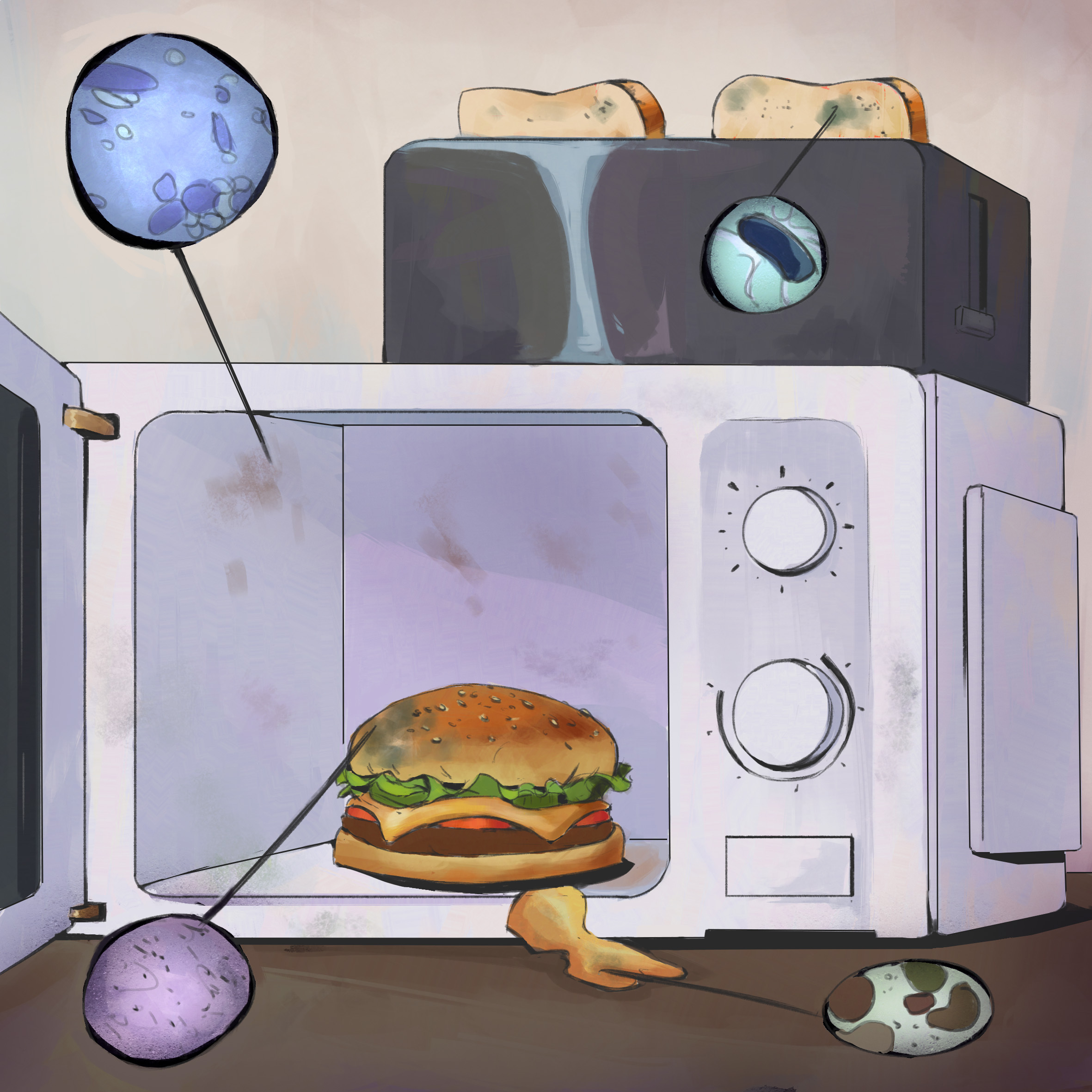
As well, according to researchers in Bangladesh, a microwave oven can help decontaminate food that is already ready to eat. In 2020, they collected food sold on the street (chicken sandwiches, pizza, chicken pâté, pasta and hot dogs), most of which contained pathogenic bacteria. By heating these foods for one minute in a microwave oven, they were able to considerably lessen bacterial contamination.
The ability of these ovens to kill bacteria is not perfect. Effectively, microwaves penetrate only 2.5 to 4 cm inside a food, according to the U.S. Food Safety and Inspection Service. So if your piece of food is voluminous enough, microwaves will be completely absorbed before they can get to its centre. The French researchers confirm this observation.
The portions that are not affected by microwaves will therefore not be heated up. The temperature will only rise as heat spreads from the outside to the inside. This means that the food must be cooked at a lower power level for a longer time, to avoid overcooking the outside. Furthermore, if the food is made up of several different substances, heat will not spread evenly.
That being sad, it is not because a microwave oven can kill bacteria that you don’t have to wash it. Some micro-organisms can exist in extreme conditions.

In 2024, Spanish researchers wanted to find out if a microwave oven itself could harbor resistant micro-organisms. They looked at ten ovens from residences, and ten others from common areas, like cafeterias.
They also identified different types of bacteria, including Proteobacteria, Firmicutes, Actinobacteria, and Bacteroides. These bacteria usually live on our skin, and are therefore found on frequently touched objects.
The Spanish researchers also identified some bacteria known for causing food infections among humans. Many bacteria detected in microwave ovens were associated with food contamination. Some could represent health risks because of their pathogenic properties and their resistance to antibiotics.
In other words, these bacteria were no different from what you might find on a kitchen counter. Their presence in microwave ovens is a reminder to always clean these appliances, as you would clean other kitchen appliances.
Microwave ovens can be used to cook food and destroy bacteria that food can carry. Since foods are different and aren’t all cooked the same way, some foods may require special precautions. Microwave ovens can also harbor certain heat-resistant bacteria if they are not cleaned often enough.
This article is part of the Détecteur de rumeurs series. Click here for other articles in the series.
Leave a Reply