
By Virginie Francoeur
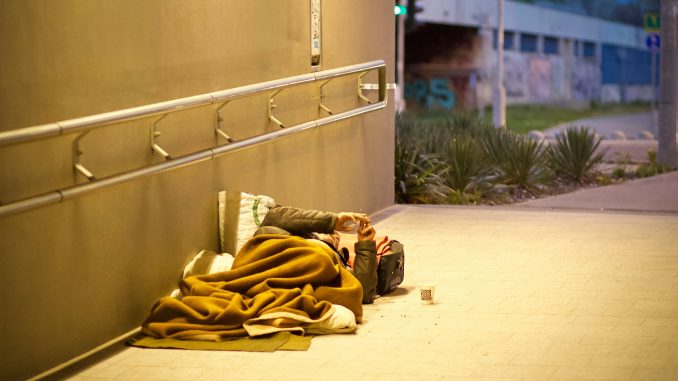
Franky prefers milkshakes. Vanilla, never chocolate. Especially the McDonald’s kind. Since he lost all his teeth, he only eats soft-serve food. Franky prefers milkshakes to yogurt. He’s not exactly into healthy eating.
Franky? I never knew if that was his real name. And it doesn’t really matter. All I know is that he never took off his black Perfecto jacket, which used to give him a Marlon Brando look. Franky had always been drawn to old cowboy movies.
Before ending up on the streets, he worked in the James Bay region. He juggled jobs as a taxi driver and a waiter. He took whatever came his way: “You know, before I was on the streets, I did a lot of things, now I don’t have much left except a battered garbage bag.” I don’t know exactly how or why he ended up like this. But that’s why people throw him quarters and tell him he should get a job. A real job!
One morning, I saw Franky again. We met at the church. The one with the red roof near downtown. He was waiting for me on the steps. I brought him some Made in China t-shirts so he could wear them under his Perfecto jacket.
No one had spoken to him for more than five minutes since he arrived in Montreal. He’d never talked about James Bay, except to Jim, his friend from Sainte Catherine Street. The only one he’d share a milkshake with. As I was leaving, Franky yelled at me: “The rest of the world doesn’t give a damn about me, but not you. I don’t know why you’re helping me, but it feels good, because now I have a girlfriend. And besides, the t-shirts are damn cool!”
And Franky turned around and walked away.
A year has passed since then. Today, Jim told me that Franky swung on a rope: “He went up to heaven with his garbage bag.” And then Jim turned around and walked away, his friend’s Perfecto jacket under his arm, his eyes gazing at a sky other than our own.
Franky’s story is not unique. It resembles so many others that society has turned a blind eye to, out of discomfort. To reverse this trend, organizations such as Lauberivière, Maison du Père, Accueil Bonneau, and Dans la rue are working tirelessly to help people experiencing homelessness or at risk of becoming homeless.
According to Statistics Canada, it is estimated that more than 235,000 people experience homelessness in Canada each year, and that between 25,000 and 35,000 people may experience homelessness on any given night. The majority are men (62%), followed by women (36%), and 2% are identified as having a gender other than their gender identity (e.g., transgender, non-binary, queer, two-spirit).
The face of homelessness is getting younger and younger. Today, I met Laurent-Hugo, his eyes vacant, uncertain about the future. He confided in me: “I turned 31 on May 5th and I had to go back to living on the street because the rents are too expensive, the time spent on the street is long, sometimes you can sleep on a friend’s couch, but too often you sleep outside, in the rain, in the cold.” Most of the time, he describes, they get kicked out, so they can’t stay more than one night. It’s always the same thing all over again: packing up their things, finding a new, not-too-squalid place to try and sleep, because they never really sleep in these conditions.
He explains that the nights are too short and the days endless, the long walks cause blisters. His girlfriend walks along the street beside him: “It’s not easy for her. I’m getting used to it a little, but not her.” With tears in his eyes, he leaves, murmuring, “We’re begging to survive.” He wouldn’t wish this life on anyone.
I met Laurent-Hugo when he was 12 or 13. His mother hired me to babysit him and his little sister. A nice apartment in Outremont, a large library, a promising future. Suffering knows no bounds. It travels from coast to coast, manifests in every neighborhood, and affects families of all social classes.
Too often, people experiencing homelessness are perceived as lacking ambition and willpower. How can we dispel these prejudices, these falsely perpetuated images? By getting involved in our community to prevent the exclusion and rejection these individuals face. By addressing the root of the problem.
No one chooses to live on the street. So many reasons drive thousands to it: job loss, unaffordable rent, drugs, relapse, domestic violence, sexual abuse, bereavement, mental illness… The causes are numerous. The solutions are sometimes obvious. The resources insufficient.
Let’s mobilize so that the Laurent-Hugos of this world don’t suffer the same tragic fate as Franky! Time is running out.
Leave a Reply