
By The Social Eyes Team
From the cover of a youth magazine to writing novels, Marianne Marion embodies what La grande journée des petits entrepreneurs (The Big Day of Small Entrepreneurs) celebrates: the strength of a dream born early, and the audacity to follow one’s dreams as an adult. Now a social worker and a writer, she shares with us, during a meeting, her take on youth entrepreneurship, getting involved early on in life, and the possibilities that open up when you dare to act.
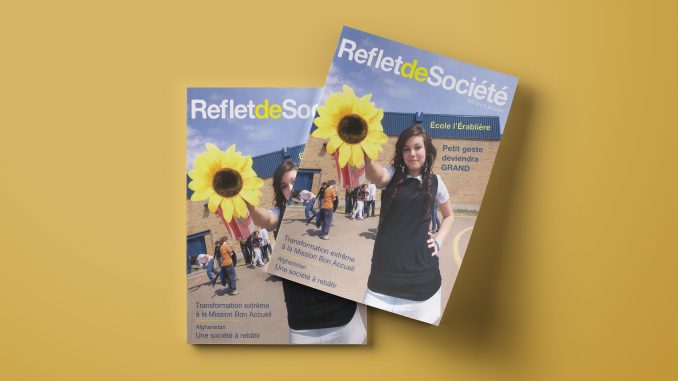
When she was in secondary 5 (grade 11), Marianne got involved in her school’s social committees. She was the communications representative. During her research, she happened across the magazine Reflet de Société and decided to contact them about a project her school committee was involved in, part of the Établissements Verts Brundtland network of sustainable development organizations active in Quebec at the time. She had the idea to contact the magazine for Earth Day, April 22, 2008. So for magazine edition 16.5, published the summer of 2008, her project appeared in Reflet de Société, and she was put on the cover.
She recalls the effect that was produced when she discovered she would be on the cover. “It impressed me, and showed that my modest social acts could be important. It gave me confidence in my social and ecological activities.”
For the magazine’s editor in chief, Raymond Viger, writing about Marianne’s project was a no-brainer. “Talking about her project raised her self-esteem. But when we put someone on the cover of a provincial magazine, their intensity is boosted and stays positively anchored for a long part of their life. We had over 500,000 readers at that time!”
The Lasting Impact of a First Encounter
Her young engagement in social and environmental projects allowed her to forge a personality, and to set goals. These activities helped her develop her self-confidence. “It is thanks to school that I could do all these projects that helped me grow up and develop. From my high school involvement with the EVB project to my Cegep candidacy to participate in a science fair in Europe, in France.”
Being recognized for her efforts so young had a propulsing effect: “Social involvement is usually behind-the-scenes. You are rarely in the spotlight. So being on the cover of a magazine highlighted my progress and greatly increased my self-confidence for my next projects. There was no negative impact in terms of appearing in the magazine.”
From Commitment to Literary Creation
Marianne has published two novels – and a third is in the offing. “I always liked to read and write. I wrote little stapled books in my room when I was young.”
But her path to writing wasn’t written in the stars. “I didn’t grow up in a family of readers. I grew up more in pop culture than in literature. When I was a child I never thought I would write a book.”
During the pandemic, everything changed for her. “In 2020, I found myself with a lot of free time on my hands… and with a young child! So, I started writing to pass the time. And by the summer of 2020, I had written 50,000 words.”
She hasn’t stopped since. “First novel, October 2021. Second, May 2022. And a third novel is finished and will be published soon.”
Marianne Marion writes contemporary Quebec romance novels featuring female characters who are crossing through major personal phases in their lives – growing into adulthood, questioning themselves, searching for their identity – often set against the backdrop of cafés or other warm, welcoming atmospheres. Her first novel, Café Tao, tells the story of two opposite personalities who learn to get along. Her second novel, Café Tourmen-Thé, explores being in one’s thirties, mental health, identity, and the crumbling of certainties, following the same characters through a new turning point in their lives.
Then there is the third novel whose title and plot we cannot reveal. It will appear in 2026.
An Entrepreneurial Youth
Marianne knows La grande journée des petits entrepreneurs well. She follows it enthusiastically: “I’ve bought bracelets, soaps, and a few items for my son. I think that this year more than ever, the event has really shone.”
She sees in the event a doorway to action. “It’s a great first contact with the entrepreneurial world. In the 1990s, it didn’t exist. If I’d had that chance, I would have jumped at it.”
In terms of today’s youth, she defends them with conviction. “We underestimate them. Yes, they consume a lot, but they are also capable of sustained effort, and they understand the value of work. Seeing the results of their entrepreneurial work, it’s educational and very motivating.” But Marianne distinguishes: “There are kids that are ready to work before the age of 14. I would have been one of those kids, but not all kids are ready for it.”
She remains lucid about the boundaries to be set, as her social worker’s viewpoint would dictate. While she applauds meaningful projects, she also calls for vigilance: “I fear that some children will become the financial pillar of their families, that they will neglect school or not even have access to the money they earn.”
She underlines a real risk: that of a confusion between autonomy and economic greed, especially among poorer families. “A child should never carry the financial responsibility of a household on their shoulders.”
She continues: “You have to look at it on a case-by-case basis. In well-structured events such as La grande journée des petits entrepreneurs, we can see some very beautiful stories come out of that.”
It is these moments of inspiration, these small projects that spark vocations, that she is keen to encourage. “Provided that we protect childhood and keep in mind that these are first and foremost spaces for learning.”
In short, she sees a difference between work for pay and selling your own creations. “A child that runs a booth selling bracelets, it’s not the same as a youth that spends their weekends working at McDonald’s.”
To Those who are Hesitant
Marianne says directly to youths: “More than ever, the possibilities are infinite. When I was young, I never would have had the courage to study literature because I needed a diploma that would lead directly to a job. But today things have changed. Opportunities are raining down.”
She dreams of concrete tools to nurture this creativity: “We should make vision boards with children to help them build their dreams.”
And her motto? “Always say yes to opportunities! Life goes by so fast, let’s keep an open mind.”
Leave a Reply