
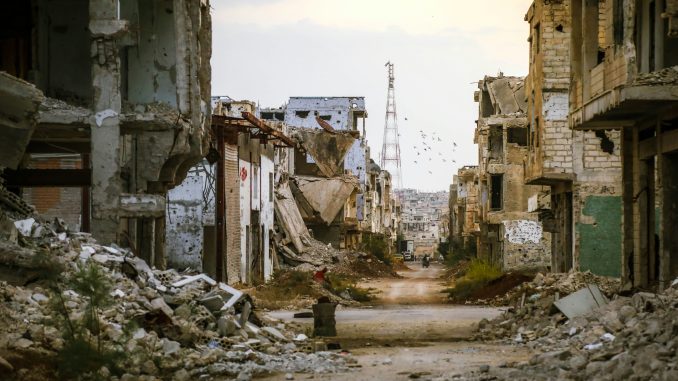
By Anne Reitzer
“I’m telling my story because I want to explain to Canadians what we’re going through, and also because I want to give some hope back to all those refugees who have lost faith in life.”
It was with these words that Ahmed began telling me his story, which started in Syria, from where he went into exile in Turkey, Greece, and Belgium, before finally landing in Montreal.
Ahmed was 18 when the Syrian revolution erupted in 2011. At the time, he was finishing his science-focused high school studies: “I chose that field because in Syria, you only have the choice between literature or science, and I wanted to study computer science in my country.”
When the demonstrations began to denounce Bashar al-Assad’s regime, Ahmed joined the marches: “At first, we were only demanding freedom and justice. We didn’t know the scale it would reach.” Indeed, the dictator didn’t see it that way and ordered the police to quickly put an end to these gatherings.
As time went on, the demonstrations grew more frequent, and the police could no longer identify the protesters. They then began firing into the crowd: “Since people were being murdered, people started acquiring weapons. Little by little, more weapons circulated, and citizens responded to violence with violence.”
Bashar al-Assad’s regime eventually lost momentum as the citizens’ demands were heard worldwide. Despite this, the regime called Ahmed up for military service, which is mandatory for all men in Syria. ”From the age of 18, you have to do it, but if you’re studying, you can postpone it. Since it was an emergency situation, I wasn’t given a choice.”
When Ahmed received his summons to join the army, he decided to talk to his family about it. Everyone agreed that Ahmed had to leave the country: “I had no choice but to flee. If I stayed in Syria, I would have either joined the army or been captured by the jihadists.”
So, in February 2012, the young man left his country alone, at the age of 19. “Leaving my family was terrible. It’s been five years since I’ve seen my parents.”
European Adventures
Ahmed took a bus to a town on the Turkish border. From there, he reached Istanbul where he met a smuggler who would help him get to Greece. “Europe was seen as an El Dorado for us,” the young man confided.
After being transported with about thirty other people in a van and walking for hours, Ahmed finally arrived in Greece. The economic crisis that was hitting the country hard made him realize he couldn’t stay there. “The country was in such a deep crisis that even if I had applied for asylum, they wouldn’t have been able to process my case. I had to go somewhere else.”
That’s when Ahmed decided to go to Belgium. “I had a cousin there, and I thought it would be easier for me to integrate. When I arrived, I immediately applied for asylum. Unfortunately, it was rejected after a year.”
Ahmed decided not to give up, however. He and his cousin rented a small studio apartment in Brussels, and he started working under the table to earn some money and send a little to his parents, who were still in Syria. But one of the biggest difficulties was the language barrier. “In Syria, I had no knowledge of French… Since I wanted to integrate, I had no choice; I had to take classes at a private school. From 7 a.m. to 5 p.m., I worked in a warehouse loading and unloading construction equipment. Then I went to my French classes from 6 p.m. to 8 p.m. I did this for four months.”
Even though his asylum application wasn’t accepted, Ahmed still obtained a temporary visa allowing him to apply for diploma equivalency and enroll at the Brussels School of Computer Science. There, he continued to work at the warehouse, adjusting his hours: “At first it was hard because I had to learn the specific vocabulary, but I loved my classes.”
Despite everything, Ahmed wasn’t able to complete his degree, even though he wanted to: “When the classes started to get more demanding, I couldn’t continue working illegally. Most of the Syrians around me didn’t want to study because they knew it was far too complicated. But I was in my twenties, I wanted to build a future for myself, and I’ve always loved learning… So I decided to continue my studies.”
With his temporary visa, Ahmed received €800 in social assistance (approximately $1,100), but his rent cost €600, in addition to bills and groceries. He decided to stop studying. “I couldn’t keep up. I thought about living in a shared apartment, but if I had, the state would have taken 300 euros from my allowance. It was hard for me: stopping the studies I loved, that stimulated me, and seeing my friends continuing their activities, going to restaurants. I couldn’t; I was so frustrated.”
On top of these financial problems, there were immigration issues. “Every year, I had to reapply to renew my temporary visa a month before it expired. But the processing could take more than two months, so during that time, you’re considered undocumented. With the Dublin Convention, you can’t apply simultaneously in another EU member state. So you’re forced to wait for a response.”
Belgium rejected Ahmed’s new application; he had to leave the European Union. “All that was left was Asia, Africa, or North America. I decided to focus on Canada; I’d heard the people there were very kind.”
New Attempt
Ahmed decided to fly to Montreal. He bought a fake passport. “I just left with my fake passport. I didn’t even have any luggage… But I was stopped on the plane. The Belgian customs officers were kind to me and explained that they understood my distress, but they couldn’t let me board.”
He tried his luck a second time, with someone else’s real passport. “I wasn’t even stressed… Since I had nowhere else to go, I figured I had nothing to lose. This time, it worked. As soon as I arrived at the airport, I went straight to a customs officer and told him I wanted to apply for asylum. I can still see his completely bewildered face as he asked me, ‘How did you even get here…?’”
Once he submitted his application, Ahmed was detained for a month. This gave immigration officials time to investigate Ahmed’s background and ensure he didn’t pose a threat to the country. “I completely understand that they want to know if I’m honest. I’m even reassured to see that they’re careful about who enters their territory. Once they’d checked everything, they allowed me to apply for asylum.”
Within two months, Ahmed found roommates, sharing an apartment with two women from Quebec City. “They’re lovely and interested in my country. People are very open-minded here.”
Ahmed will now be able to resume his computer science studies at Concordia University and intends to continue to thrive. “Fleeing my country, leaving my family and living through so many years of hardship has made me resourceful. Of course, I still suffer, but I have found hope again… and I’m holding on to it.”
Top: Photo by Mahmoud Sulaiman
Leave a Reply