
By Colin McGregor
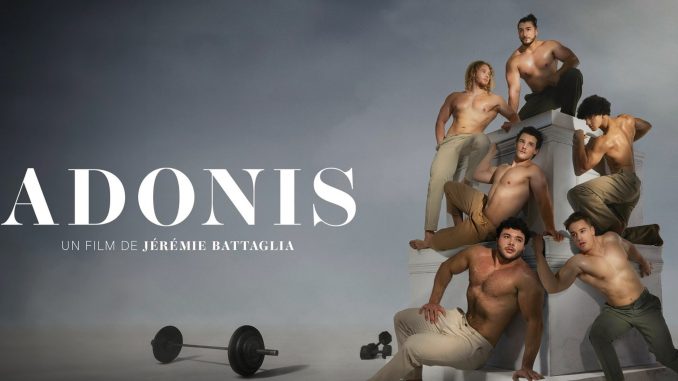
The documentary film Adonis is a report on youth bodybuilding culture. Audaciously tackling the taboos that exist around masculine beauty, Adonis reveals the depths of the public health crisis at play.
Jérémie Battaglia, the documentarist, is originally from France but makes his home in Quebec. He explains that a lack of true self-esteem and self-love among young men often leads to « bigorexia ». That’s a phenomenon that leads muscle-bound youths to see themselves as skinny when they look in the mirror. They compensate with even more weight training.
Mr. Battaglia conducts interviews with twenty young bodybuilders to talk about the rapport between their bodies and bodybuilding. Many open up about the links between their self-esteem and the act of lifting weights, as well as their consumption of supplements. According to Anthony, 23: “The effect of being the strongest isn’t really what’s most important for me, it’s really more the aesthetics, of feeling good in my skin.”
Tristan, 20, explains that: “You can have millions of dollars, you can have super expensive watches and cars… The body is the only thing you can’t buy… There’s a lot of respect that goes with that.”
Normalized Illegality
Even though it is illegal to sell steroids in Canada, there are hundreds of websites in Quebec and across the country that sell both steroids and SARMs (Selective Androgen Receptor Modulators). SARMs are illegal experimental drugs that have steroidal effects but pose a danger to one’s health.
The filmmaker shows how easy it is to buy a whole array of these banned products by mail. Despite the prohibition on selling them, it is not illegal to possess them. In the documentary, some youths share their experiences with these substances.
Thomas, 19, tells us “I know lots of people who take them. Too many, in fact.” Gabriel, 23, observes: “It’s worse than you think. Doping products are all over the place in gyms, and in each gym, several people are selling them.”
According to a University of Toronto study, 2.8% of young Canadian men between the ages of 16 and 30 admitted that they were using or have used doping products to get in shape. Researchers believe that this figure is an underestimate, due to the stigmatization involved.
Steroid use is risky. It has some terrible side-effects, including acne, nausea, muscle cramps, loss of sex drive, uncontrollable shaking, and heart problems that can lead to death.
According to one study published in the journal Addiction, anabolic steroids, originally created for horses, carry a 30% addiction rate. That’s higher than heroin, cocaine or alcohol.
Another study, in the journal Drug and Alcohol Dependence, concludes that steroid users are nine times more at risk to commit a violent crime. Their death rate is three times that of the general population, according to a University of Copenhagen study.
Government Laxism
There is no awareness campaign or government program to dissuade youths from taking steroids. As the filmmaker says: “They’re playing Russian roulette, to complete indifference.”
Marc-Antoine Grondin, a well-known Quebec physical trainer and bodybuilder, runs down his own health problems. Two big toes that are finished, the reconstruction of his abdomen…
He observes that “There isn’t one contestant in Mr. Olympia (the world’s premiere bodybuilding competition) who is healthy. They’re in shape, but they’re not healthy. This needs to be addressed.”
Mr. Battaglia isn’t afraid to reveal his own vulnerabilities in this area. When he was an awkward teenager in the south of France, he dreamed of modifying his own body. In France, gym culture isn’t as pronounced as it is in Quebec.
He spent many hours lifting weights, unsatisfied with his own muscularity. He understands the quest for the perfect body and how these youths think. They think that if they are muscle-bound, they will be more appreciated by their peers, since “the body is the only thing a person can control.”
“Building your identity on one thing, like bodybuilding and muscularity, is dangerous,” Mr. Battaglia concludes. During a question-and-answer session after a screening of his film, he explains that these bodybuilders often come from the lower echelons of society. They use bodybuilding to compensate for a lack of fulfillment in their careers.
Sparking a Craze
The filmmaker finally left bodybuilding behind. He learned to accept himself for who he is. But the allure of bodybuilding remains strong among young men. Simon, 19, reveals that “I am obsessed by my physical shape.”
Mathias, 23, admits: “I always felt looked down upon by others… I was too small, not strong enough. Since I began training, I’ve gained self-confidence.”
According to Louka, who is only 18: “I would rather live to 50 doing what I like than to live to 80 telling myself, you could have done that. I do what I love.”
Many years ago weightlifting was not a popular activity in North America. That is, until two Montreal brothers, entrepreneurs Ben and Joe Weider, brought a young Austrian to the United States in the 1960s: Arnold Schwarzenegger. He sparked a craze in terms of the appearance of the male body.
The Weider brothers made a fortune thanks to their magazines, their fitness equipment, and their bodybuilding contest, Mr. Olympia. Just look at the number of fitness gyms that exist today to see how their empire affected the culture. However, as Marc-Antoine Grondin says: “We sell images of hyper-development, of hyper sexualization. But they are all false.”
Adonis — 2024, 52 minutes — can be watched for free in French on the Télé-Québec website.
Photo credit: Jérémie Battaglia
Leave a Reply