
By Oumou Diakité
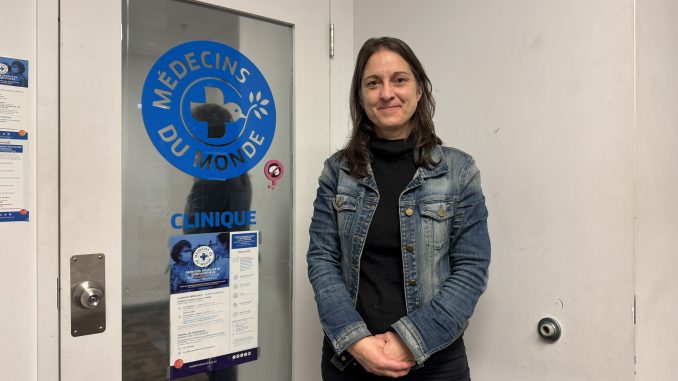
When Pénélope Boudreault thinks about where it all began, she laughs softly: “June 2006… that makes it 20 years that I’ve been working as a nurse. I had a backpack, I was walking on the street, I went to see people.”
This image – a young nurse advancing to the rhythm of Montreal, attentive to those sleeping under the city’s bridges, foreshadowed her future. Two decades later, nothing has changed in her approach to healthcare: keep things real, stay close to the sidewalk and its broken lives.
Before becoming National Operations and Strategic Development Director for Doctors of the World (Médecins du Monde, or MDM), Pénélope worked as a nurse with POPS, the Montreal organization that helps homeless youth. She saw first-hand the violence of injustice. “I wanted to go abroad, but I found the perfect job here. The needs were present. I could really bring something.”
From her arrival at MDM, she was introduced into their teams of two, all coming from the same backgrounds as their patients: natives, ex-migrants, people who had survived homelessness. “They helped us understand, adapt, create bonds. Working with rather than working on people: that was our approach.”
The DNA of MDM is linked with a rupture at its founding: “During the war in Biafra in the 1960s, Doctors Without Borders had doctors working there who wanted to bear witness to what they were seeing while they cared for the population. But that was forbidden because they were working for the Red Cross. During a meeting in Paris, a majority voted to lift this restriction of not being able to describe situations. Those who wanted to speak out formed Doctors of the World.”
This double mission – caring and bearing witness – remains basic to the organization. And speaking out doesn’t just apply to far-away crises: here in wealthy countries, the suffering of marginalized populations often festers in the shadows. For over 30 years MDM, founded by Dr. Bernard Kouchner, has been rooted in Montreal. For several years, Quebec health care professionals have intervened around the world, under the leadership of MDM’s president Dr. Réjean Thomas, an HIV specialist.
Today, MDM Canada continues to work on advocacy, defending rights, and improving access to health care for people with precarious status, sex workers, urban Indigenous persons, and those experiencing homelessness. “Even in our wealthy countries, there are people who do not have access to health care,” notes Pénélope Boudreault.
Birth of a Clandestine Clinic
In 2006, MDM Canada created a clinic for migrants, a pillar of the organization’s ideals. It started with two nurses, their backpacks and their will to go to see those most vulnerable. They offered front-line health care, without heavy burdens: just the first spark for this initiative.
In 2009, demand exploded. Cases of migrants without health coverage multiplied on building sites, in restaurant kitchens, and at businesses with precarious jobs to offer. Volunteer doctors took action. The clandestine clinic was born, hidden out of fear of being intercepted by immigration officials. “We showed up at night to avoid our patients being identified,” recalls Pénélope Boudreault.
From the shadows, a new clinic was born that was more structured and open. Today, MDM works with laboratories, private clinics and physiotherapists to offer free or low-cost health care. The goal has not changed: to facilitate access to the health care system without creating a parallel system. Its financing remains fragile, dispersed among the municipal and federal governments, as well as the province’s health care and social services departments. Nonetheless the clinic stays alive… notably because it answers a serious need.
Rolling Health Care
In 2001, MDM Canada set up a mobile clinic. It has become a major on-the-ground intervention tool. It offers on-the-spot support and care; psycho-social support and accompaniment; prevention and risk reduction. These specialized services are offered via regular visits every two weeks to individuals referred by street workers in Montreal. The idea is to go see people where they are, rather than waiting for them in an office.
MDM’s mental health department was born 15 years ago to support community social workers working for various organizations. They work on the street. Psychologists meet people marked by violence, fear of being sent back to their country of origin, guilt over not being able to help their families back home, or the difficulties involved with rebuilding a new life here.
Origins may get more diverse, but the mental health issues remain the same. A lack of finances prevents the hiring of a psychologist for the migrant clinic, a “critical need,” according to Pénélope.
When Caring Changes the Law
Just providing health care isn’t enough. Bearing witness is part of MDM’s mandate. For Pénélope, the challenges go beyond the medical. Housing crisis, systemic racism, confusion over immigration, the erosion of the social safety net: everything is getting more complex. “We don’t dream of winning battles. We just try to not go backwards,” she says.
The organization played an important role in one major advancement: access to the RAMQ for children of migrants with a precarious status, thanks to Bill 83, adopted on September 22nd, 2021. “A child born here may have citizenship, but not health insurance. We worked hard on that alongside pediatricians and immigration activists.”
MDM is also against restrictions on supervised consumption sites, arguing that health policy should never be constrained by punitive logic.
Stories That Stick
In her work, some stories persist more than others. She recounts how an indigenous street social worker followed up on a homeless lady who completely rejected all offers of assistance. “I can just walk with you,” the social worker said. A few weeks later, the lady accepted help. The social worker admitted feeling “privileged.” It’s a bond of confidence that statistics can never demonstrate: dignity is built in twos.
To prevent emotional burnout, MDM organizes retreats for its teams and individual clinical supervision for its employees. The organization offers flexibility to parents and ongoing support to caregivers.
A Holistic Vision
The future of MDM involves the setting up of an indigenous outreach health clinic co-developed with the communities. A holistic vision, where western means of care are proposed, but never imposed. “The system compartmentalizes too much. We organize things around the individual,” Pénélope says.
“Sometimes we feel like we’re swimming upstream. But when someone says they support our mission, it makes us feel good. We feel less alone.” She smiles. “We get compliments sometimes. That helps.”
Doctors of the World, or Médecins du Monde, is not simply an organization: it’s a staunch refusal to let those who society has forgotten fall by the wayside. In this refusal, Pénélope Boudreault is one of its most determined voices. And one of its most humane.
Photo of Pénélope Boudreault by Oumou Diakité
Leave a Reply